

SAN DIEGO -- Baseball careers don’t have to end when the games stop.
Sometimes, as in Eric Patterson’s case, it simply marks a new beginning.
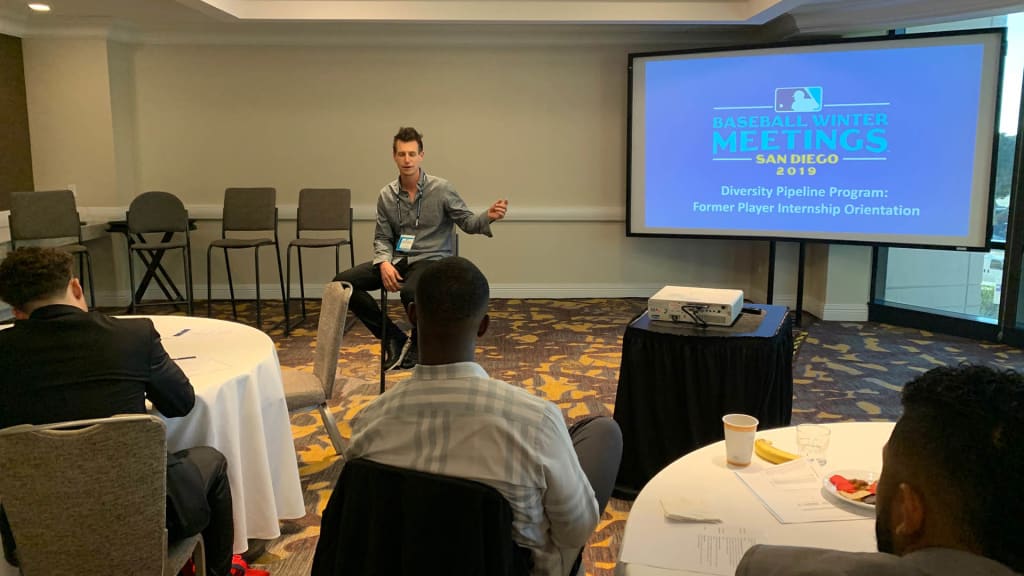
Patterson, who played five seasons with the Cubs, A’s, Padres and Red Sox starting in 2007, is one of 18 former professional players participating in the new Former Player Internship Program, a six-month initiative designed to provide former Major League and Minor League players from diverse backgrounds the tools to help them transition from the playing field to jobs in front offices and on coaching staffs.
“We knew it was important to create a pipeline program and were already doing what we could to help a diverse people -- men and women -- that were already in the game develop,” said Paul Mifsud, vice president and deputy general counsel for MLB. “This is just one of many programs in the Diverse Pipeline Program that is designed to seed talent into the front offices and the field staffs of the Major and Minor League teams to grow diversity throughout the game.”
The initiative, which is sponsored by the MLB Player Programs and the Diversity Pipeline Program departments, held its day-long orientation Monday at the Manchester Grand Hyatt, the site of the 2019 Winter Meetings. The 18 participants in the program are each paired with a different team.
“Having played at the highest level and being away from the game so long, it’s great to see how the game has evolved and how it’s run,” said Patterson, 36, who will spend his internship with the Cubs. “Being here was an absolute no-brainer. It’s a great opportunity and I’m so excited to be a part of it.”
A group of top MLB officials that included Deputy Commissioner Dan Halem, Chief Baseball Officer Joe Torre and Chris Young, Vice-President of On-Field Operations – Initiatives and Strategy –welcomed the group. Cory Schwartz, MLB’s Vice-President of Data Operations Strategy, Technology and Innovation, followed with a 30-minute presentation about Statcast.
Next up was Dodgers manager Dave Roberts and Brandon Gomes, the club’s Assistant General Manager, along with Johnny Washington, San Diego’s director of Minor League hitting, and Bobby Scales, Pittsburgh’s assistant field coordinator. The group shared their coaching experience and career path for an hour.
“This program is certainly beneficial for the game,” Roberts said. “When you are talking about opportunities for minorities in various capacities, whether it’s in the [research and development] side, coaching, or in scouting, I felt like I could share my experience. I am paying it forward a little bit. I was given an opportunity and I wanted to show my path and maybe it can somehow help them find their way.”
John D’Angelo, MLB’s Vice-President of League Economics and Strategy, and Jeff Pfeifer, Senior Director of League Operations joined Cardinals Assistant General Manager Moises Rodriguez for a 45-minute discussion about the Draft, international scouting, and transactions.
The next panel centered on succeeding in the workplace and featured Yankees Assistant General Manager Jean Afterman, along with Yankees pro scouting directors Matt Daley and Dan Giese. Cleveland Vice-President of International Scouting Paul Gillispie and Chanda Lawdermilk from Tampa Bay’s staff development and recruiting department also participated.
The busy day also included a star-studded discussion on working in the front office that featured Brewers manager Craig Counsell, Mariners General Manager Jerry Dipoto, Colorado Special Assistant Danny Montgomery, Milwaukee Vice-President of Baseball Operations Matt Kleine and Tyrone Brooks, MLB’s Senior Director of Front Office and Field Staff Diversity.
Later, De Jon Watson, Washington’s Special Assistant to the GM, Ehsan Bokhari, Houston’s director of research and development, and Sean Johnson, Minnesota’s director of amateur scouting, also addressed the participants.
“We think that they are going to be able to contribute significantly to the health of the game going forward,” Mifsud said. “We want them to know that there is a network of supporters at the League level in all aspects of the game. What we are at the league is a support structure for them. They have many lifelines at the Commissioner’s Office for whatever area of the game you are in.”