
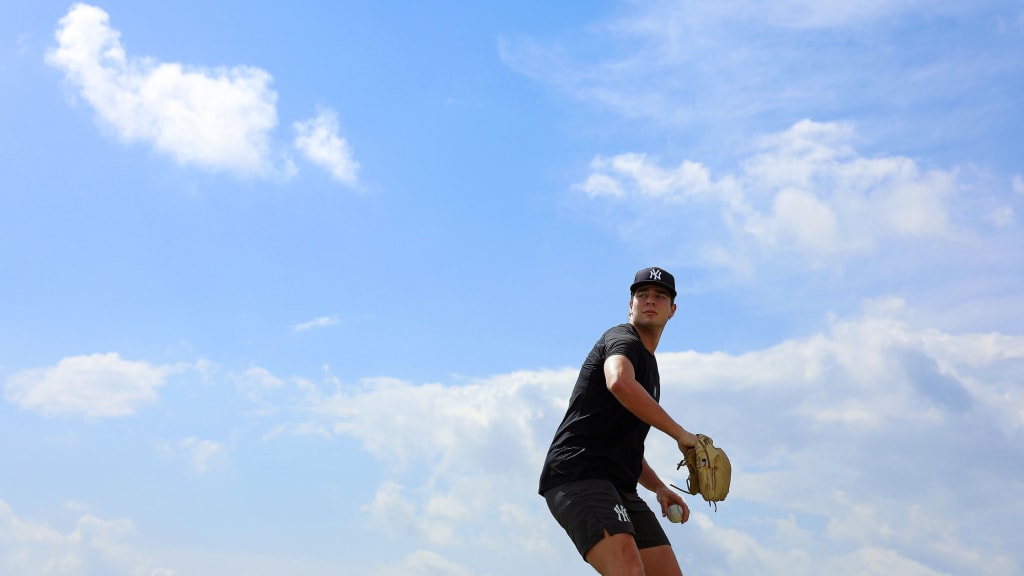
For any baseball player who dreams of reaching the big leagues, the road is a tough one. More than 40,000 college players compete in the NCAA each season; barely 600 are selected in Major League Baseball’s amateur Draft. Thousands of players -- not only from the college circuit but from all around the world -- vie for the opportunity to be among the 780 active players on MLB rosters on any given day, and every one of them has had to overcome myriad hurdles just to keep that dream alive.
Hunter Dietz knows all of this.
A highly touted prospect since his high school days, the Yankees’ 2026 first-round Draft pick’s road has been anything but charmed. Yet as he fought through injuries during his collegiate career, Dietz developed a mental toughness and a competitive edge to go along with the elite arm talent he always possessed.
And the 27-time World Series champions noticed.
A 6-foot, 6-inch, 235-pound left-hander with a fastball that can touch 98 miles per hour, Dietz was ranked by MLB Pipeline as the No. 17 overall prospect in the 2026 Draft class after excelling during this past season at the University of Arkansas. Striking out 131 batters -- third most in a loaded SEC considered to be the best conference in the country -- Dietz posted a 7-4 record as a redshirt sophomore for a Razorbacks team that set a program record with 12 players selected in this year’s Draft.
That a talent such as Dietz was still there for the taking all the way down at No. 35 was a pleasant surprise for Yankees vice president and director of amateur scouting Damon Oppenheimer.
“The pitching part of it was not a priority; it was the typical, ‘Let’s take the best player available,’” Oppenheimer said. “It seemed to us that teams have become conscious about targeting hitters and maybe moving them up past some pitchers just to do it, which allowed some high-end pitching to get down to that pick at 35 that we probably wouldn’t have expected.”
Yankees scouts have admired Dietz since his days pitching for Calvary Christian High School in Clearwater, Fla., just 15 miles west of the team’s Spring Training headquarters in Tampa, Fla. “We were able to see him quite a bit,” Oppenheimer said. “We followed him to Arkansas, and then this year, he really burst onto the scene to [become] what we thought he would be out of high school: a big, powerful left-handed pitcher.”
After a meeting with team brass at the MLB Draft Combine in June, Dietz said he still wasn’t sure that the Yankees were interested until a call came from his adviser near the middle of the Draft’s first round. When the selection became official, he was thrilled to know that he would likely begin his professional journey close to home.
“I knew that the Yankees’ Rookie-ball team is in Tampa, and their Spring Training is in Tampa,” Dietz said, “so I knew I wouldn’t be far from home. I was kind of relieved to get the Draft process over with. Now, I’m just excited to get to work.”
***
Dietz’s potential was apparent long before he earned All-SEC honors and was named an All-American by Baseball America this past season. Ranked by Perfect Game as the No. 7 left-handed pitcher and the No. 57 overall high school player in the class of 2023, Dietz joined an Arkansas program that had 11 College World Series appearances to its name at the time. He arrived with high expectations, but adversity found him soon after arriving in Fayetteville.
In the fall of 2023, Dietz underwent surgery to repair a stress fracture in his left elbow, and after making two relief appearances as a true freshman, he saw his 2024 season cut short due to another injury, this time season-ending. The 2025 campaign brought similar challenges, with Dietz appearing just twice in an injury-plagued season in which he could never get to the level he and his coaches knew he was capable of reaching.
“My freshman year, my mindset was just looking forward to getting back on the field and not thinking about the injury too much,” Dietz said. “I had a mindset that everything’s going to be all good. I struggled mechanically the next year, so I never got back on the field just because I wasn’t performing at a high enough level to pitch in the SEC.”
For Arkansas pitching coach Matt Hobbs, faith in Dietz never wavered.
“He came to us and was great in that first fall, and we thought, plug-and-play starter right away,” Hobbs said. “And then he got hurt and missed the better part of 18 months, so he kind of went away from us for a while. The development early in his career was just about rehabbing and getting him healthy.”
Maintaining his confidence was a struggle during the recovery process. But through it all, Dietz learned a lot about himself.
“I knew how good I was and how good I could be, but it just wasn’t clicking at the time,” Dietz said. “That was a pretty big mental struggle, but being able to get through that, that helps me a lot as a pitcher. Being able to have gone through that helps me for my future. I learned a lot about my resilience and my ability to adapt and try new things, my coachability and stuff like that.”
During his second year at Arkansas, the Razorbacks were one game away from the 2025 College World Series final, falling to eventual-national champion and SEC rival LSU. Dietz remained supportive of his teammates through it all, something his coaches took note of.
“The people that really paid attention to his story, it’s such a great model of what perseverance looks like,” Hobbs said. “Being able to go through the ’25 season, where we go to Omaha and we’re a couple pitches away from having a chance to win the thing, him knowing that if he could have been healthy he could have really helped us, that says a lot about his toughness to be able to come back and have the season that he had as a junior. He was able to put that behind him, deal with the frustration of not being able to do the thing you love to do and then go do it at a high enough level to go in the first round.”
***
His redshirt sophomore season was when Dietz reminded everyone who he truly is. It would be the first time that he assumed the starter role that Arkansas projected for him when he arrived on campus nearly three years earlier.
In his first career collegiate start, Dietz struck out five in two innings against No. 10 TCU at Globe Life Field in the Shriners Children’s College Showdown. Dietz continued to find his footing as the season progressed, striking out nine over four innings in a start against Xavier, and then captured his first win as a Razorback after allowing just two hits while striking out eight and allowing no earned runs in a Feb. 28 game against UT-Arlington.
Dietz’s 2026 season was rife with dominant outings, including an 11-strikeout, two-run performance in a win at No. 18 Auburn. He then struck out nine in six innings of two-run ball in a win over No. 8 Alabama. He also picked up a victory against No. 5 Georgia in which he allowed just two runs in 5 1/3 innings with six K’s.
By season’s end, Dietz had proven to be one of the best pitchers in all of college baseball.
In an All-SEC, All-America campaign, he limited opposing batters to a .221 average, tossing 85 2/3 innings with a 3.57 ERA and finishing as a semifinalist for the Golden Spikes Award and the Dick Howser Trophy, each given to the top amateur baseball players in the country.
What has made Dietz so effective is an arsenal that includes a curveball, cutter and slider in addition to the fastball which Hobbs considers to be Dietz’s best pitch.
“The velocity, for college, is extreme, being up to 98 mph,” Hobbs said. “That’s a big number for college, especially left-handers. And he can pitch in to righties, which makes it really effective, so he can cross the plate with his fastball. He can go to the top of the zone and get a lot of swings and misses with it, too. He’s got some good qualities to his fastball that allow him to pitch up there. But really, it’s just that the angle he creates is so steep.”
The release height, Hobbs said, puts Dietz in rare company.
“His release height, I think, was 6-9, which would put him in the top two or three percent of college pitchers,” Hobbs said. “And his extension was 6-foot-8 or 6-foot-9 -- that put him in the top 15 percent of college pitchers.”
Asked to evaluate his repertoire himself, Dietz highlighted his cutter, which he called his “most effective pitch” right now.
“I lean on that pitch the most out of my four just because it is the most consistent,” Dietz said. “I’m able to throw it where I want it, when I want, in any count, to any hitter, getting inside of the plate. But I’m looking forward to expanding my repertoire as the time here comes, and I’m super excited to get going.”
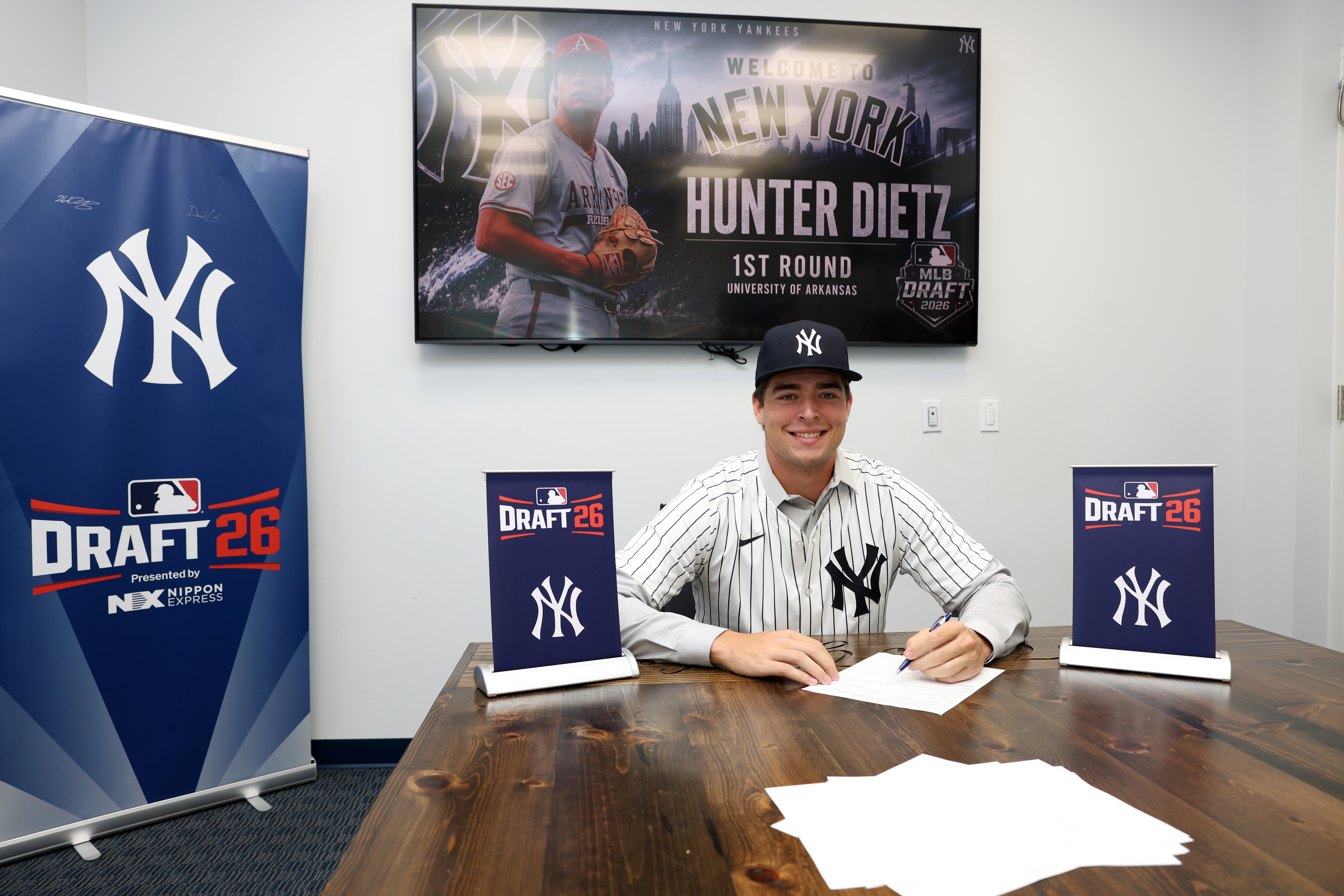
Oppenheimer said Dietz is exactly the kind of player the Yankees look for, given his arsenal and build. “He’s big, strong; he fits our mold,” Oppenheimer said. “He’s got a big fastball that’s up to 98. It’s got movement. He’s got a slider that’s basically kind of a wipeout, strikeout pitch, and another pitch that is a curveball we think can be developed, so he’d have two breaking balls and the big fastball, and the control just keeps getting better.”
As far as intangibles go, competitiveness is what sets Dietz apart -- although that is not always evident once he steps outside the lines.
“He’s a very mild-mannered kid, and it doesn’t seem like there’s a lot to him,” Hobbs said. “It’s not like he’s a super outspoken kid, so sometimes that’s perceived as maybe not caring as much as somebody that’s very high strung and super high effort, and Hunter is just the exact opposite of those things. He’s just a wonderful kid that does all the right things and was ultra-competitive.”
Competitiveness to go along with skill is something that both Hobbs and Dietz agree were a requirement in the SEC, and that experience, Dietz said, has prepared him to take the next step.
“I feel like it prepared me as much as you can before the pros,” Dietz said. “SEC development on top of Cape Cod the summer before, playing baseball every day, I got a glimpse of what pro ball would be like. I’m looking forward to it. I faced a lot of good hitters and really good teams, really good lineups in the SEC, so hopefully that experience helps me a lot.”
***
Thinking that having just one full season of college starts under his belt makes Dietz inexperienced would ignore all of the hard work and life lessons he gained during his college career -- lessons that will go a long way as he enters the pros.
Of his battle with injuries, Dietz said, “While I hate that it happened, I’m grateful because I learned a lot about myself. I feel like it’s just a lot of understanding my body. Two years ago, I didn’t really understand how the body moved efficiently, but it was really last year, understanding the mechanical adjustments I had to go through and understanding how my body moves, and how efficient I can make my body move. It’s kind of the biggest adjustment I’ve made. Also, just mentality-wise, standing on the mound, it’s a job that I’m going to get done for my team. It’s a ‘kill’ mentality when I’m on the mound. Each and every pitch is its own individual pitch.”
Having arrived in Tampa shortly after signing to begin the training process and prepare for next spring, Dietz said the high standard he experienced at Arkansas has guided his approach to his professional development -- and his hope that he can help the Yankees win at the highest level.
“Showing up to the field at Arkansas every day, I wanted to get better, I wanted to give the team a chance to win, and showing up here is no different,” Dietz said. “I’m here wanting to get better, and I’m looking forward to the chance to hopefully down the line help the Yankees win. I think that’s what everyone here is thinking, and what everyone around Arkansas was like. Arkansas is very down to business. You go there, you get to work, you get your job done. Here, I come here and get to work, so it’s similar. I like how I already have a bunch of that stuff ingrained in me.”
Robert Hudson is an associate editor with Yankees Magazine. This story appears in the September 2026 edition. Get more articles like this delivered to your doorstep by purchasing a subscription to Yankees Magazine at www.yankees.com/publications.