

Green Monster
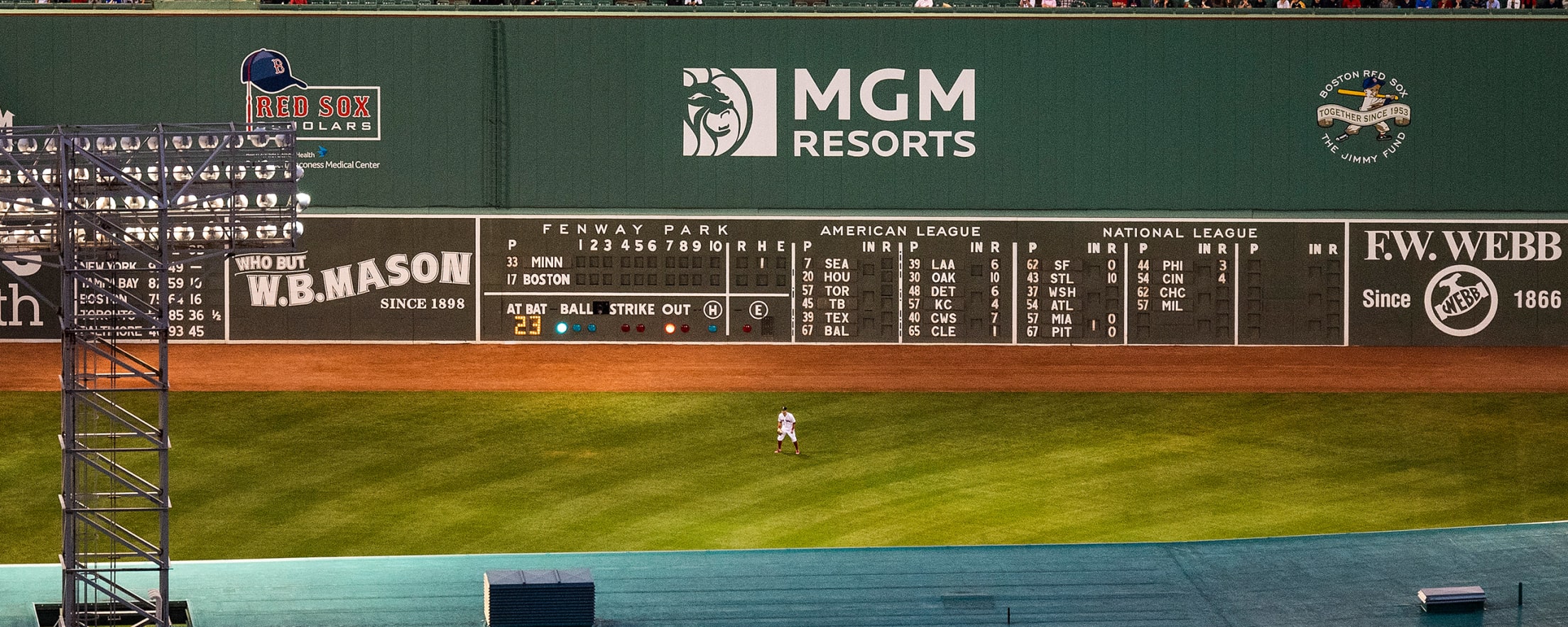
Fenway Park's "Green Monster" — the 37-foot, 2-inch wall that extends 231 feet from the left-field foul line to the center-field bleachers — is arguably the most iconic feature of any ballpark in Major League Baseball, rivaled only by Wrigley Field's ivy-covered walls and the upper-deck façade of Yankee Stadium.
The wall did not exist in its current incarnation when Fenway Park opened on April 20, 1912. The original wall was a 25-foot wood-plank fence held fast by horizontal supports known as "whalers" on the backside, built to keep spectators from watching from the Boston Garage Company across Lansdowne Street. The fence was fronted by a 6-to-10 foot earthen embankment, which extended from the bleachers to the property line and was needed because the plot of land on which Fenway Park was built was on an uneven grade, higher on the street side. The embankment was soon dubbed "Duffy's Cliff" because of the skillful way Red Sox left fielder Duffy Lewis navigated the incline in pursuit of fly balls. During the 1912 World Series against the New York Giants, seven rows of bleachers were temporarily installed on the embankment. First baseman Hugh Bradley, a Holy Cross graduate and native of Worcester, Mass., hit the first home run in Fenway Park on April 26, 1912, in the seventh inning of a 7-6 victory over the Philadelphia Athletics. Bradley's three-run home run, which erased a 6-4 deficit, cleared the wall in left field, which previously had been thought to be out of reach of hitters in baseball's "deadball" era. Paul Shannon, writing in the Boston Post, called it a "feat that may never be duplicated.''
The original left-field scoreboard was nearly identical to the one built in Detroit's Navin Field, which opened on the same day as Fenway Park in 1912. It was called an electronic scoreboard, but that was only partially the case; a press box keyboard operator communicated information to the scoreboard operators electronically. Operators behind the scoreboard then scrambled up and down a network of ladders and steps and benches and manually slid markers into slots. A new scoreboard debuted after Fenway Park was renovated for the 1934 season, the first truly electronically operated scoreboard in baseball with its red, green and yellow lights to signal balls, strikes and outs. It remains one of two manually operated scoreboards in the Major Leagues, the other being in Wrigley Field.
When Fenway Park was renovated for the 1934 season, work crews leveled Duffy's Cliff and replaced the wooden fence with what we now know as the Green Monster. The lower 18 feet of the wall was concrete and topped by a 19-foot frame made of 2-by-4 railroad ties bolted together, the entire structure covered with a skin of tin. The wall's reinforced steel-and-concrete foundation extended 22 feet below field level. Red Sox left fielder Julius "Moose" Solters hit the first home run over the new wall on April 19, 1934, a walk off home run in the ninth inning of a 5-4 victory over the Washington Senators in the first game of a Patriots Day doubleheader. Newspaper reports said Solters' home run off General Crowder of the Senators went into the windows of the auto shop across Lansdowne Street. In 1936, a 23-foot, 7-inch net was placed on top of the wall, to protect the windows of business establishments across the street. It was a prudent decision: right-handed slugger Jimmie Foxx would hit 217 home runs over the next six seasons, including 50 in 1938. In 1947, the year light towers were installed in Fenway Park, the Red Sox elected to scrape the ads that had adorned the wall and painted it "Dartmouth green" to match the rest of the ballpark.
It is unclear when the term "Green Monster" first was used. For many years — through the 1980s — it was usually referred to as "The Wall." In a 1958 story, Boston Globe reporter Hy Hurwitz referred to the "easy to reach green monster in Ted Williams' territory," and a UPI story on August 24, 1960 referred to a double off Fenway Park's "Green Monster." Red Sox reliever John Wyatt in 1966 referred to the "jolly green monster" in left, and during the 1967 World Series frequent references were made to the Green Monster. After the 2002 season, the team's new ownership group, headed by John Henry and Tom Werner, decided to remove the screen atop the wall and replaced it with 269 barstool-type seats, which have quickly become among some of the most highly sought seats in the ballpark.